
Compensation is the number one reason candidates walk away from offers, cited by 41.5% of hiring leaders.
That alone isn’t surprising. What’s more telling is what sits behind it:
- 58.1% of companies don’t offer equity
- 54.5% spend under $10K annually on recruiting
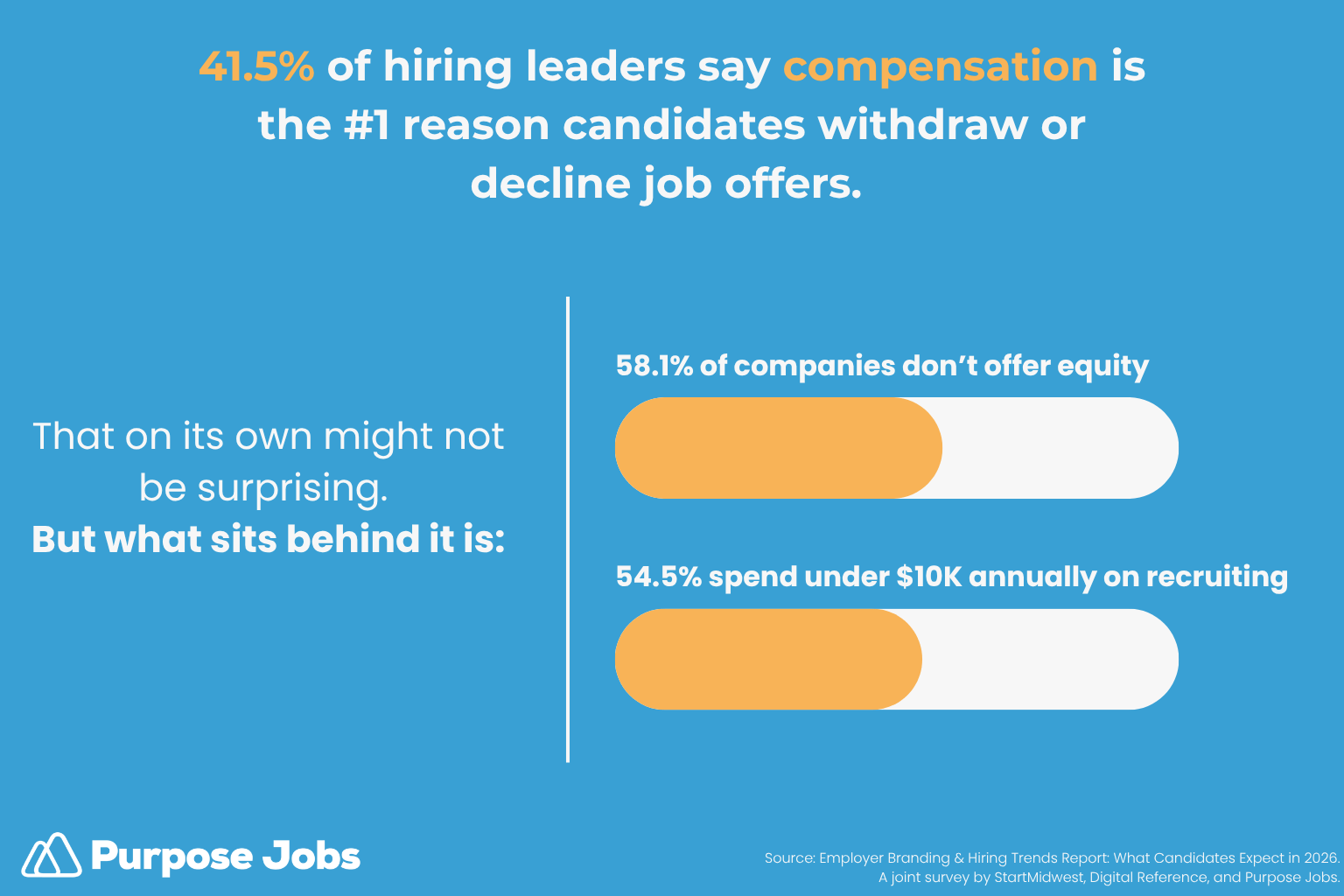
Many startups simply don’t have the financial flexibility to compete on salary, and they’re not offsetting the pay gap with meaningful investment elsewhere.
For candidates, this shows up as offers that feel underwhelming or incomplete.
For employers, it creates a cycle where roles stay open longer, and top candidates opt for companies with clearer or more compelling value propositions.
This is where employer brand stops being a “nice to have” and becomes a core hiring lever.
When compensation can’t carry the offer, candidates evaluate everything else more critically:
- What does it feel like to work here?
- Do I believe in the mission?
- Will I grow?
- Do I see people like me succeeding here?
Purpose, belonging, and clarity aren’t soft factors — they’re the differentiators that close the gap when salary can’t.
When asked what content most effectively attracts candidates, the answer wasn’t compensation.
It was culture and values — by a wide margin.
- Culture & values: 34.9%
- Compensation & benefits: 14%
- Customer impact: 14%
- Leadership POV: 14%
Candidates aren’t just looking for what a company pays. They’re trying to understand what it stands for and whether they belong there.
.png?width=800&height=533&name=Employer%20Branding%20Report%20Stats%20(1).png)
But there’s a second layer to this: format matters.
Video is outperforming text in a meaningful way:
- Video-based employee stories: 26.2%
- Video-based leadership stories: 16.7%
- Combined video: 42.9%
- Combined text equivalents: 31%
Candidates don’t just want to read about culture — they want to see it, hear it, and experience it. And yet, many companies still rely on static job descriptions and generic careers pages.
There’s a disconnect between what candidates respond to and what employers are producing.
For purpose-driven companies, this is a clear opportunity. Authentic storytelling — especially through employee and leadership voices — is one of the highest-impact investments an employer can make.
Flexible work isn’t emerging — it’s already here. And it’s been here.
- 81.4% of companies are very familiar with fractional talent
- 56.1% are actively using fractional executives
The most commonly outsourced functions:
- Marketing: 73.3%
- Legal: 60%
- Design: 43.3%
Companies are building teams differently and prioritizing flexibility, specialization, and efficiency.
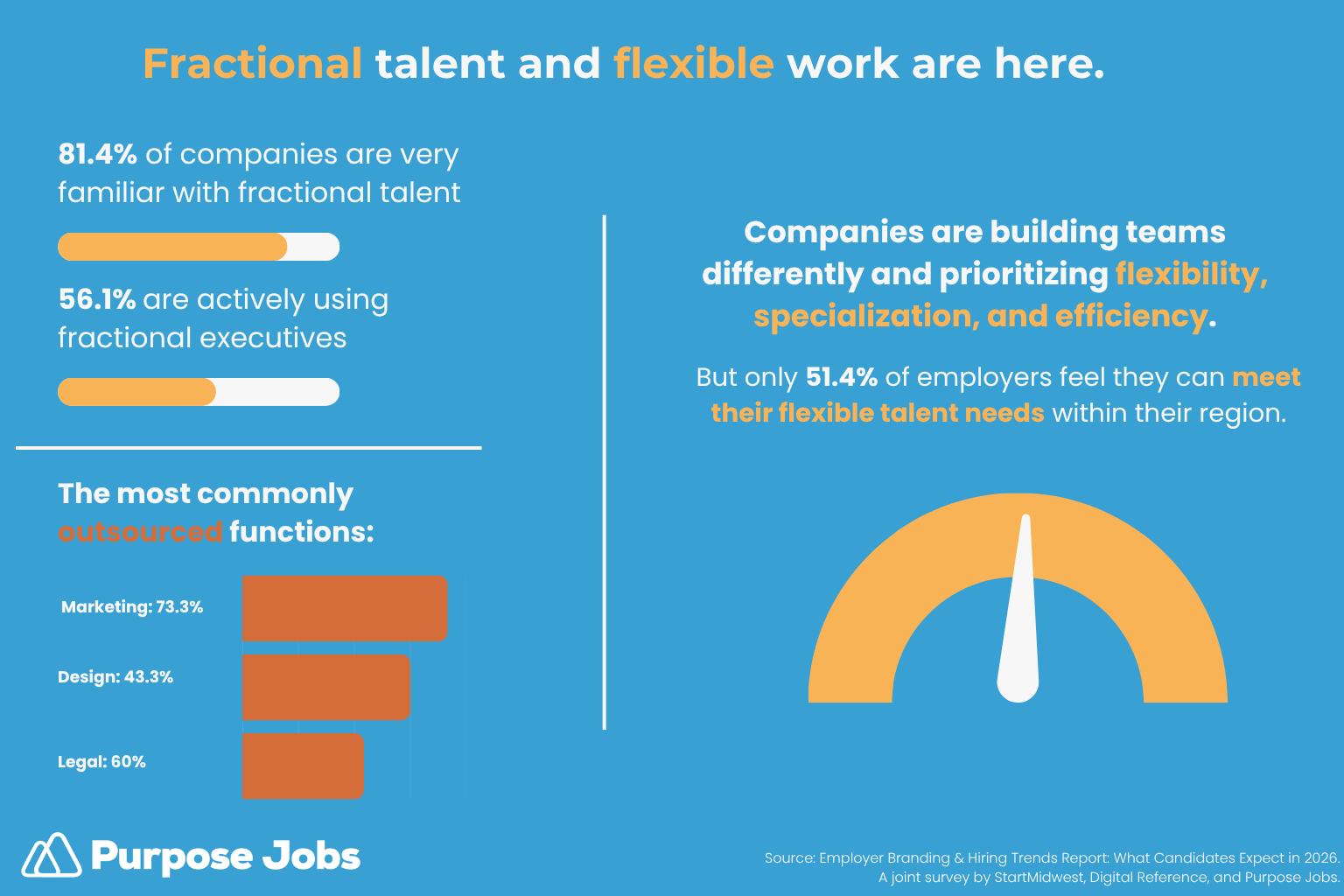
But only 51.4% of employers feel they can meet their flexible talent needs within their region. Nearly half are looking outside their local ecosystems to find the expertise they need.
For Midwest startups and purpose-driven companies, this is both a challenge and an opportunity.
It signals:
- A growing demand for fractional and flexible talent
- A regional talent pipeline that isn’t fully developed or connected
For job seekers, it opens new pathways into meaningful work, especially for those looking for flexibility or portfolio careers.
For employers, it highlights the importance of visibility and connection within regional communities.
The companies that build strong local networks — and clearly communicate opportunities — will be better positioned to tap into this growing segment of the workforce.
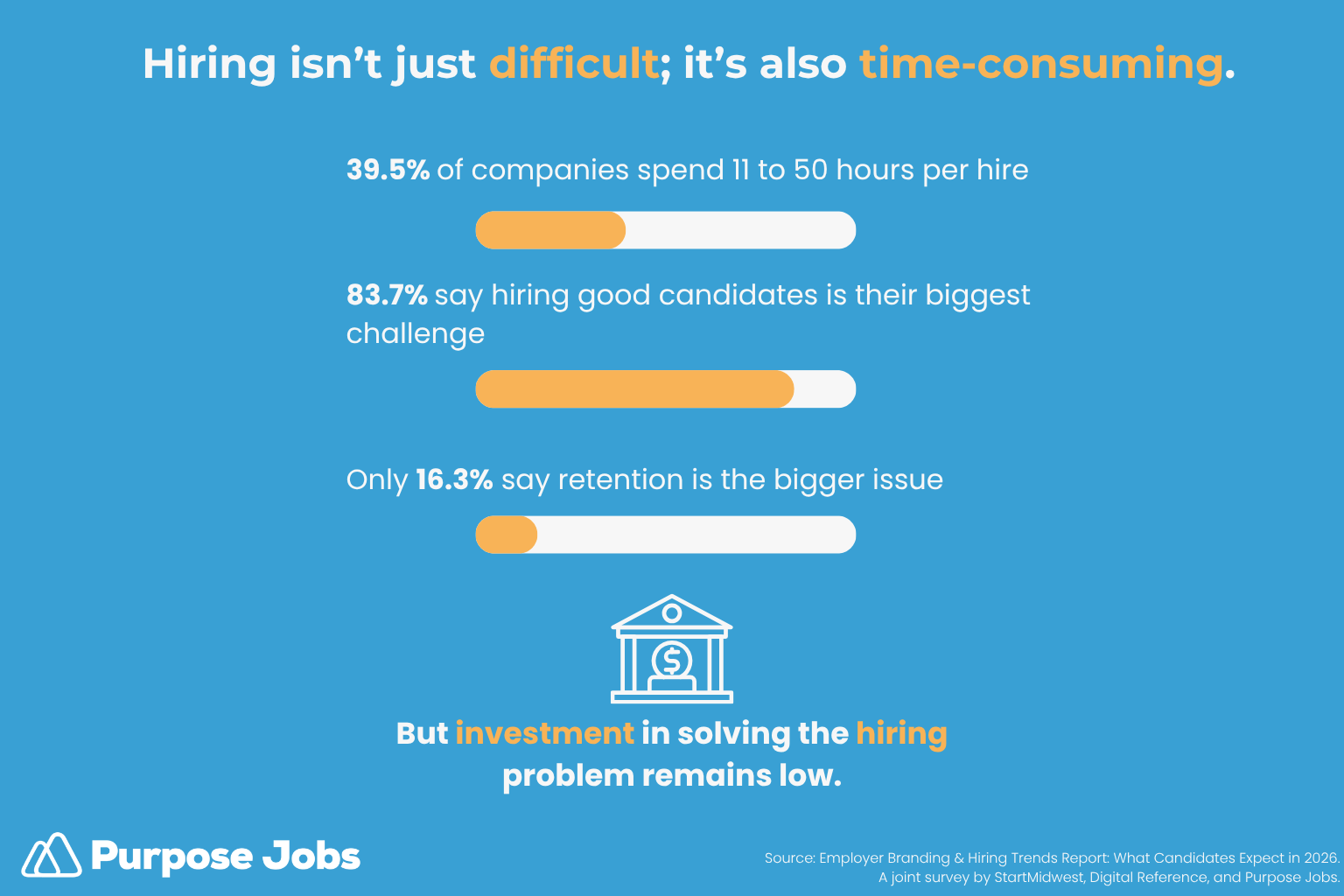
Hiring isn’t just difficult; it’s also time-consuming.
- 39.5% of companies spend 11 to 50 hours per hire
- 83.7% say hiring good candidates is their biggest challenge
- Only 16.3% say retention is the bigger issue
Despite this, investment in solving the problem remains low:
- The majority spend under $10K annually on recruiting
- Nearly half have minimal employer brand investment
- 81.8% still rely on manual resume review
Hiring is the top priority for companies. It consumes significant time, and it directly impacts growth. And yet, it’s still being approached with limited resources and largely manual processes.
For employers, this often leads to burnout, inefficiency, and inconsistent results.
For candidates, it shows up as slow processes, unclear communication, and missed opportunities.
The companies that break out of this cycle are the ones that treat hiring as a strategic function — not an administrative task.
To hire better, companies need to:
- Invest in employer brand
- Create content that attracts the right candidates
- Streamline and modernize hiring processes