
.png?width=50&name=Erin%20Gregory%20(1).png)
A job opportunity might be the catalyst for a move, but it's rarely enough on its own. Whether someone ultimately says yes often depends on everything that comes with relocating: finding a place to live in a competitive housing market, arranging child care, navigating schools, and building a life that feels sustainable in a new community.
That web of practical questions, from housing and child care to transportation, talent, and available space, is exactly the territory economic development works in. And it shapes far more than one family's relocation. It affects whether a region's companies can grow, whether new ones put down roots, and whether the people who live there have good jobs and a community worth staying in.
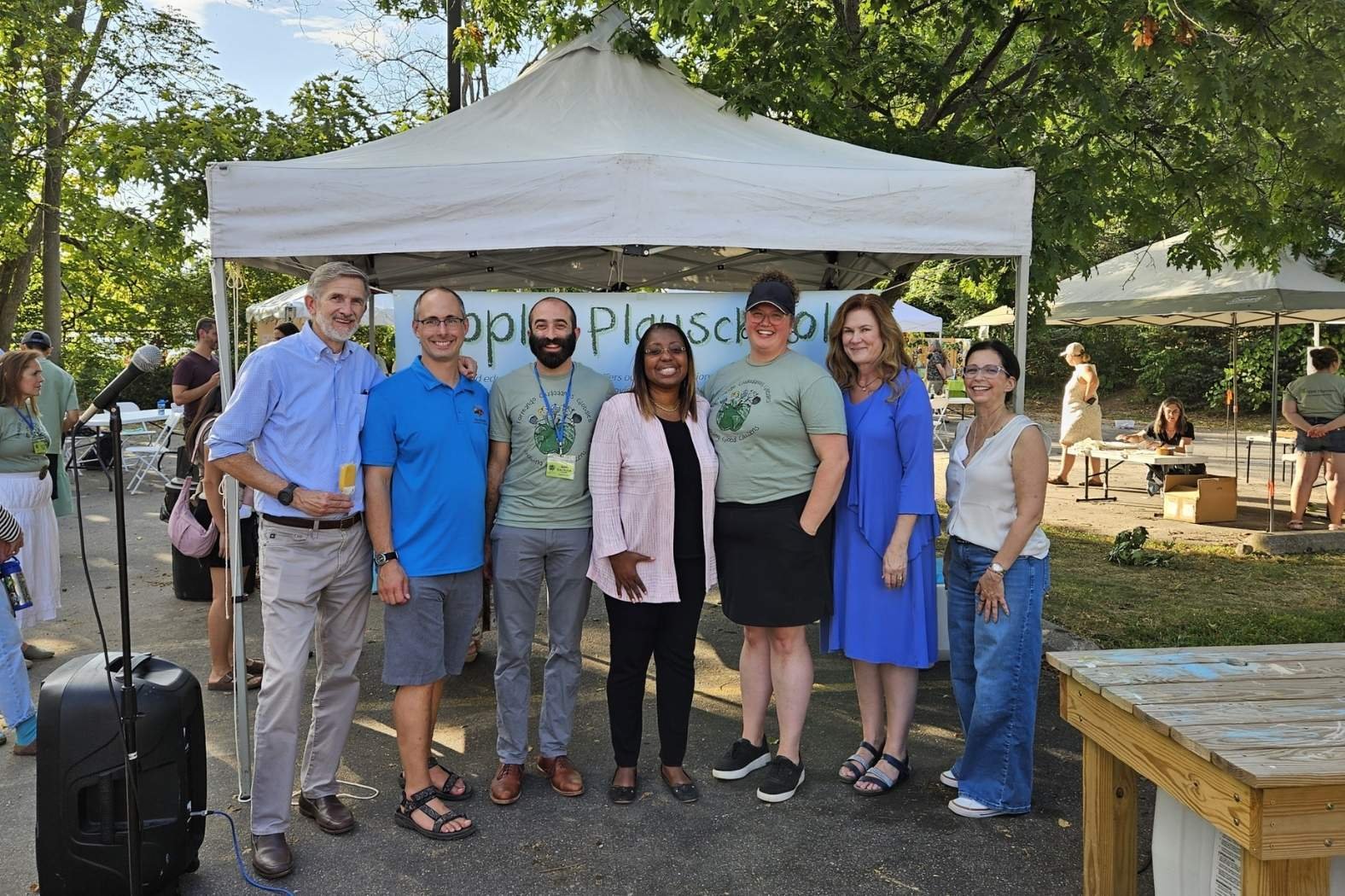
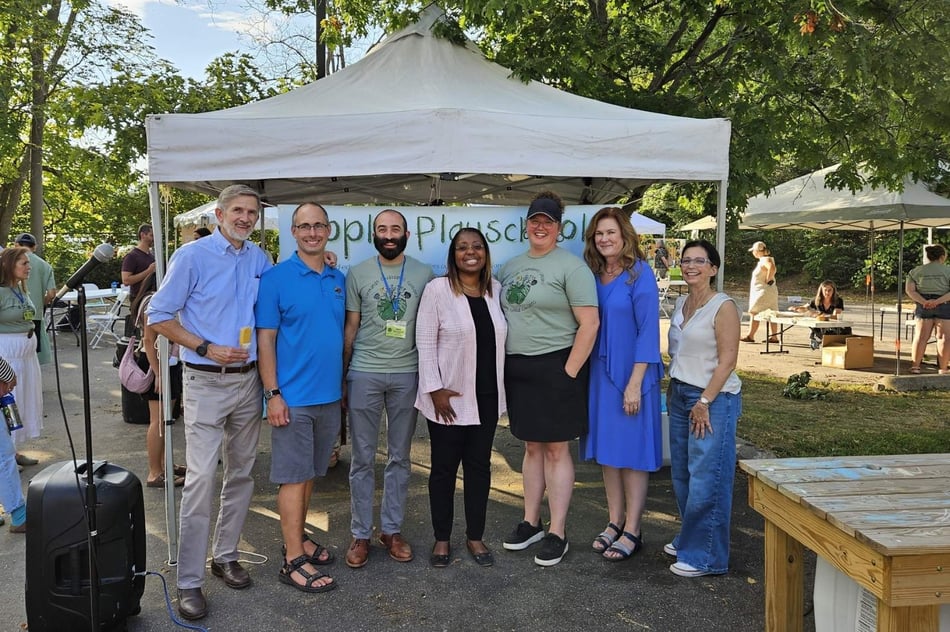
Apple Playschools and the Ann Arbor Area Community Foundation celebrate the Impact Investment that helped Apple Playschools open a new center, provided by Apple Playschools
What economic development really is
Economic development is often mistaken for recruiting companies or handing out incentives. At its core, it's about helping businesses start, grow, and stay in a community. When companies succeed, they create jobs, invest in facilities, generate tax revenue, and support the services and amenities residents rely on. The work often happens out of sight, removing barriers to growth and connecting businesses with the resources they need to thrive.
Much of the work goes to companies already here, not just new arrivals. Ann Arbor SPARK, the economic development organization for Washtenaw County, works with startups, manufacturers, technology companies, life sciences firms, and mobility innovators as they navigate expansion projects, connect with talent, and work through the challenges that could otherwise slow them down.
Jennifer Olmstead, Vice President of Business Development at Ann Arbor SPARK, puts it plainly: pitching the area is the easy part; the place does much of the selling on its own. "Ann Arbor is a great place to live, and as a resident, we want great resources," she said. "We want our trash picked up, we want great schools. And to have those resources, we need a strong tax base. Economic development is really about growing the tax base and having thriving companies so we can have thriving communities."
She came to the work through urban planning, and the community side is what's kept her in it. "My mission in life is to do things to better my community, and that's what I get to do at SPARK every day."
The super connector
Most of Olmstead's day is spent clearing obstacles for companies trying to start, scale, and succeed in the region. The biggest one right now, she said, is uncertainty. "Companies want to be certain before they make decisions. So if there's any uncertainty in the process, that puts a project on hold." A company wants to recruit someone, but that person can't find a house, can't get their child into daycare, or no one can say how long it will take to build out a new space.
SPARK's job is to take those unknowns off the table by connecting companies to the people who can answer them. "They know their business, but they don't know how to get a permit. They sometimes don't know who to call to get their child into daycare, or they don't have a relationship with the University of Michigan or Eastern Michigan University," Olmstead said. "So our job is to be the super connector, to connect them to the resources and help break down the barriers."
.jpg?width=1576&height=1050&name=Photo%20Credit_%20Apple%20Playschools%20(1).jpg) The "Bunny Burrow" classroom at Green Apple Nature Playschool 2, provided by Apple Playschool
The "Bunny Burrow" classroom at Green Apple Nature Playschool 2, provided by Apple Playschool
A real-world test: child care
Some barriers are bigger than a single permit, and child care is one that SPARK couldn't simply route around. "We try to stay in our lane, focusing on helping companies launch, grow, and expand," Olmstead said. "But when people were coming back to work after the pandemic, that was really when they realized, hey, we don't have flexibility anymore, and child care is getting so expensive." Companies couldn't recruit or keep people without it. So SPARK helped fund a state-connected study and convened a regional coalition to work on the problem.
Etta Heisler joined early. As Executive Director of Apple Playschools, a nonprofit child care organization in Ann Arbor, she's a business leader who happens to work in child care, and she credits SPARK with carrying that world to the people who can act on it. "What working with Phil [Santer] and other folks at Ann Arbor SPARK has done for me is help translate what's going on in the child care crisis for the larger business community, and in many cases, for municipal and county leaders," she said.
She saw the obstacles firsthand on her own project. Heisler was renovating a building for a new center, with state grant funds on the line, when challenges in Ann Arbor's permitting process nearly sank it. Centers have to clear municipal zoning, county health, state fire, and state licensing reviews, and some of those requirements contradict one another. "Ann Arbor SPARK came in and helped me figure out what was going on," Heisler said. "I'd never even done a renovation at my house. I didn't understand anything about the permitting process." SPARK helped her survey the ordinances, pulled in city council members, and made the case for change. Several of the most burdensome requirements were removed last spring as a result of sharing the challenges the project faced.
"No one will ever know that's a project I helped work on," Heisler said. "It's one of the things I'm most proud of." Today, Apple Playschools runs four child care centers and a school-age summer camp across Ann Arbor.
Solving the barriers to growth
Child care is just one example. In other cases, the barrier is a vacant property that needs redevelopment, a shortage of available industrial space, a site that isn't ready to build on, or an employer that can't connect with the talent it needs. Housing and transportation come up constantly. So do the relationships a company new to the region doesn't have yet, whether with the permit office, the county, or the local universities.
What ties them together is the instinct behind the child care work: economic development, done well, is less about any single fix than about getting the right people, the ones who wouldn't otherwise be in the same room, around a problem until it moves forward.
The payoff usually takes years to show up, and when it does, it looks like ordinary good news: a startup hiring dozens of people, a research company expanding into new space, a manufacturer investing millions in a local facility. Behind each one is usually a long stretch of coordination among businesses, municipalities, universities, workforce partners, and organizations like SPARK.
For SPARK, all of it serves one larger job: making Washtenaw County a place that companies, and the people they hire, actually choose, and then stay. The work looks the same whether the obstacle is a permit, a house, or a daycare seat. "People expect things to move quickly, and they don't always," Olmstead said. "So it's managing those expectations, and helping them get through each step of the way." SPARK sits in the middle of a company, its workers, and the place they're all trying to build a future, and makes the connections that turn a hard decision into an easy one.
Most residents will never see the meetings, phone calls, partnerships, or problem-solving that happen behind the scenes. But they experience the results every day: new career opportunities, growing companies, revitalized spaces, stronger local services, and a community positioned for long-term success. That's economic development in practice, and it's the work organizations like SPARK are doing every day.


%20(1).jpg?width=1200&height=500&name=techtown-mental%20health%20(1)%20(1).jpg)