.png?width=50&name=Erin%20Gregory%20(1).png)
You might not know it, but Ypsilanti, Michigan, a city of just under 20,000, has been turning out technology used around the world for generations. One example: in the 1950s, researchers at Willow Run built one of the first working synthetic aperture radar systems, a way to make sharp images of the ground from a moving aircraft, even through clouds or at night. That technology is on satellites and fighter jets today, and a company called CACI (previously Radar & Sensor Technologies) still does that work in Ypsilanti now.
Where it all started
During World War II, the Willow Run plant built B-24 Liberator bombers. At peak production, they were building close to one an hour. After the war, Willow Run Laboratories opened on the site in 1946, where researchers first made synthetic aperture radar work in the air. They produced the first focused airborne radar image in 1957 of Willow Run Airport itself.
The lab became the Environmental Research Institute of Michigan in 1972, and its radar work continued through a line of owners to the group that operates in Ypsilanti today as Radar & Sensor Technologies, now part of the national security company CACI International.
The same kind of technical work that began at Willow Run still goes on in Ypsilanti, in companies that aren't household names.
The Ypsilanti companies driving impact
CACI International builds synthetic aperture radar and geospatial intelligence systems for the U.S. government, and much of what it does is classified. The group has changed hands several times in recent years, from Maxar to ARKA and, in 2026, to CACI International, but the work has stayed in Ypsilanti the whole time. Stephanie White of Radar & Sensor Technologies points to the universities within reach as part of the reason. "When we were looking to stand up a new facility, we looked around, and Ypsilanti offered a lot of benefit to us. It's central to a number of universities. Eastern, of course. We've got Michigan Ann Arbor, Dearborn, Wayne State, Michigan State." She also points to the range of the place itself, from city life to open country, depending on what an employee wants.
LuxWall makes Net Zero Glass, a vacuum-insulated window built to stop the heat loss of ordinary glass, and it manufactures the product in Ypsilanti. Founder and CEO Scott Thomsen has said the city and township made the practical side of growing, down to permitting, straightforward.
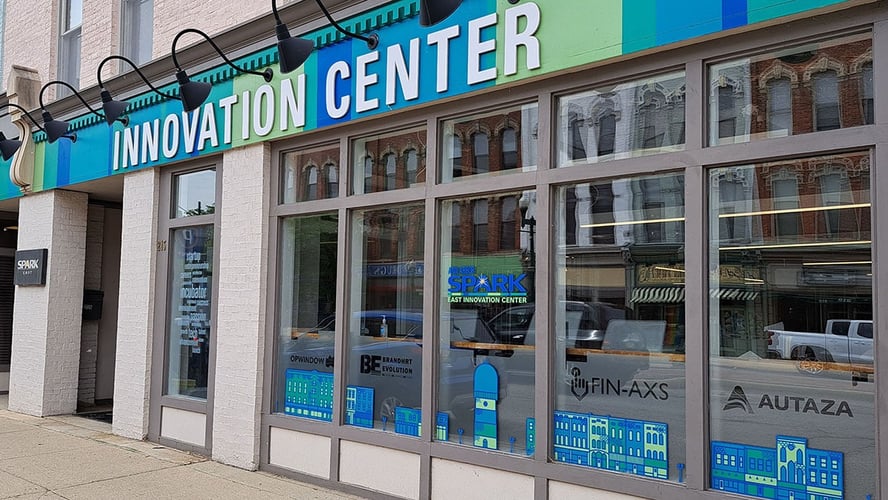
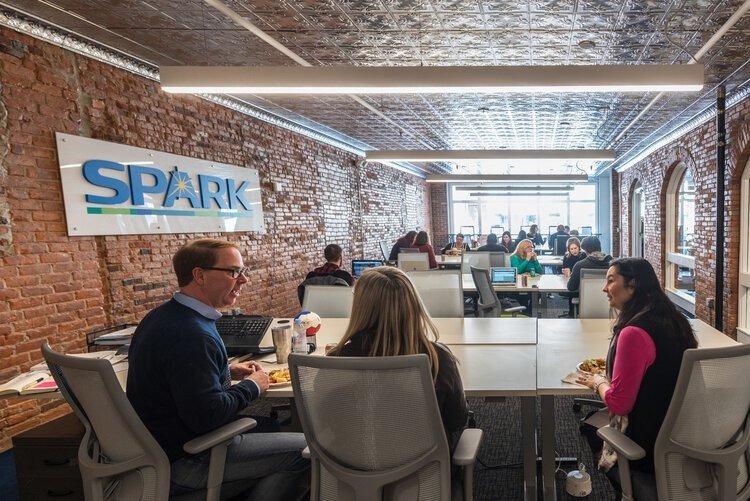
LaVision Inc. builds laser imaging and flow-measurement systems that engineers use to see how air moves over a car body or how fuel burns inside an engine, for customers in automotive and aerospace research worldwide. The Ypsilanti office is the U.S. arm of a German company and is based at the SPARK East Innovation Center downtown, where it is the anchor tenant. SPARK East has been an incubator and home for local technology companies since 2008. "We are focused on helping businesses locate in our area, and we also help businesses get started and grow and thrive," says Kristine Nash-Wong, its director of entrepreneurial services.
Still a technology town
These companies give two main reasons for choosing Ypsilanti: engineering talent from the nearby universities, and support from Ann Arbor SPARK when they were starting out or expanding. Both come up across Ypsilanti's five-mile startup corridor.
The conditions that first made Ypsilanti a place to build technology are still in place, and the SPARK East Innovation Center is part of keeping them that way. From startup services to business expansion services, Ann Arbor SPARK's business development team works on the practical side of growing here: site selection, permitting, state incentives including the Michigan Research and Development Tax Credit and the Michigan Business Development Program, and hiring support through the SPARK job portal.
For more on what companies in the area are working on, see SPARK's Ypsilanti page.